The short answer
A dental implant needs enough bone to hold it. Where the jawbone has shrunk, it can sometimes be built back up with a bone graft, or with a sinus lift in the upper back jaw. Small grafts are often placed at the same visit as the implant. Larger ones are done first and left to heal, which Guy’s and St Thomas’ NHS Foundation Trust puts at three to six months in most cases. A graft adds time, cost and some extra risk, and it is not always needed: in some cases a shorter implant, or one placed at an angle, does the job without one.
At Horsforth Smile Clinic, bone grafting is from £400 and a cone beam CT scan is £150. Implant consultations are free. Prices are correct as of October 2026 and subject to clinical assessment.
Suitability for treatment depends on a clinical assessment. This treatment may not be appropriate for every patient.
Why an implant needs bone
An implant is a titanium post that does the job of a tooth root. It only works if the bone around it is thick enough and tall enough to hold it while it heals and to carry the load of chewing afterwards.
Two things commonly leave too little bone. The first is time: the ridge of bone that held a tooth tends to shrink once the tooth has gone. The second is anatomy. Above the upper back teeth sits the maxillary sinus, an air space behind the cheek, and a Cochrane review describes the bone there as limited by “the presence of the maxillary sinus together with loss of alveolar bone height”.
The only way to know how much bone you have is to measure it. Leeds Teaching Hospitals NHS Trust explains that a cone beam CT scan “is usually requested” before implant treatment. It shows the roots of neighbouring teeth, the nerves, the nose cavity and the sinuses, and it measures “the amount of bone in the area”.
The types of bone graft
“Bone graft” covers several different procedures. Which one applies depends on how much bone is missing.
A small graft placed with the implant
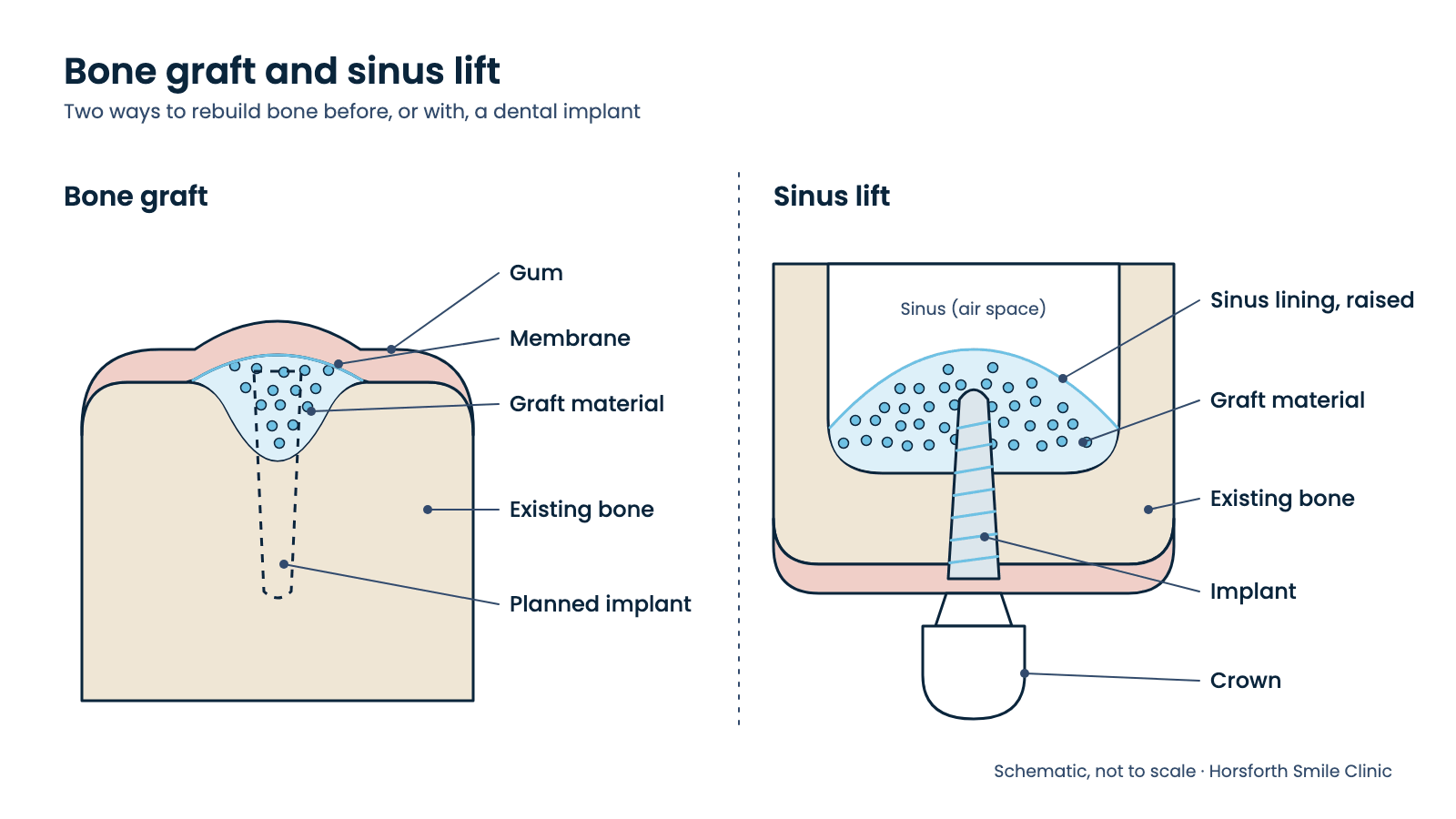
Where the shortfall is small, the graft and the implant can go in at the same visit. The Leeds leaflet describes bone chips taken “from the area around the implant site”, which may be combined with particles of bone substitute. The chips or particles are protected by a membrane placed under the gum.
A graft placed before the implant
“If more bone is needed, grafting is done several months before implant placement,” the same leaflet says. Guy’s and St Thomas’ describes minor bone grafting as taking a small amount of bone from another part of the jaw, usually the back of the jaw or the chin, under local anaesthetic. The procedure “usually takes 1 hour to 1 hour 30 minutes”, the graft is held in its new position with small pins or screws, and the stitches come out about a week later.
Larger grafts
Where a lot of bone is missing, a block of bone is needed. It can be taken from inside the mouth or from the hip. Both NHS trusts note that grafts from the hip are carried out under general anaesthetic with a stay in hospital, so that is hospital treatment.
What the graft is made of
Graft material can be your own bone, donated human bone, bone from an animal source or a man-made substitute, and the membrane that covers it may be man-made too. Guy’s and St Thomas’ notes that the body is “less likely to reject your own bone”. If the source of the material matters to you, for religious or any other reasons, say so before treatment. You are entitled to know what is being used and where it comes from.
What is a sinus lift?
A sinus lift is a bone graft for the upper back jaw. In the words of the Cochrane review, sinus lift procedures “increase bone volume by augmenting the sinus cavity”, using the patient’s own bone, a bone substitute or both. The Leeds leaflet puts it more simply: sinus grafting uses bone substitute particles “to increase the height of bone”, so that there is enough for an implant to sit in.
Depending on how much bone is there to start with, a sinus lift can be done at the same visit as the implant or as a separate first stage that is left to heal.
Do you always need a graft?
No, and this is the part that is often left out. A graft is one answer to thin bone, not the only one.
- A shorter implant. The Cochrane review of sinus lifts found the evidence “insufficient to determine” whether a sinus lift or a short implant (5 to 8.5 mm) was more successful one year after loading, where the bone was 4 to 9 mm high. It did find “more complications at sites treated with sinus lift procedures”.
- Avoiding a vertical graft. A second Cochrane review, of grafts that build bone outwards or upwards, concluded that short implants “appear to be a better alternative to vertical bone grafting” in shrunken lower jaws, and that complications, “especially for vertical augmentation, are common”. The authors cautioned that these conclusions rest on few, small trials.
- An angled implant. In full-arch treatment such as All-on-4, the back implants are placed at an angle to use the bone that is available. A 2021 review of 11 studies in the upper jaw found no statistical difference in survival at three years between angled implants and straight ones (Mehta and colleagues).
- No implant at all. A bridge or a denture does not need a graft. The Leeds leaflet lists both as alternatives, and we have compared implants, bridges and dentures side by side.
Which of these is realistic for you is a judgement made from your scan, not before it.
Healing and recovery
A bone graft “is a type of surgery. It can cause swelling, bruising and pain,” in the words of Guy’s and St Thomas’. After minor bone grafting, the trust’s advice to its own patients is that:
- most people need painkillers such as paracetamol or ibuprofen
- swelling of the jaw can last one to two weeks
- a course of antibiotics is given to lower the risk of infection
- a diet of soft foods may be recommended
- the grafted area should not be brushed for a week, and a chlorhexidine mouthwash is used instead
- a denture may have to be left out for up to two weeks
- most people can return to work after one or two days.
Then the graft is left alone. “In most cases, we leave the bone graft to heal for 3 to 6 months before you can have your dental implant treatment,” the trust says, and with a graft “your treatment might take 4 to 6 months longer”. Our guide to how long dental implants take sets out the other stages.
The risks
Guy’s and St Thomas’ lists the risks of a bone graft plainly:
- pain, swelling and bruising in the area the bone is taken from
- infection of the graft
- the graft not producing enough bone: “Sometimes, there is not enough successful bone to do dental implant surgery after a bone graft. If this happens, you might need more bone graft surgery.”
- a higher risk of failure for some people, “particularly those who smoke”
- “a higher risk of failure if we put the dental implants into grafted bone rather than natural bone”.
These are the reasons a graft should be recommended only where it is needed, and why the alternatives above deserve a proper conversation. If you smoke, the trust strongly recommends stopping: it reduces the risks of implant treatment, and smoking can delay wound healing.
What a bone graft costs
At Horsforth Smile Clinic, bone grafting is from £400. The price depends on how much bone is needed, so the “from” figure is a starting point, and your written treatment plan gives the figure for you. A cone beam CT scan is £150, a single implant is from £2,200, the implant consultation is free and IV sedation is complimentary with all implant treatments. Prices are correct as of October 2026 and subject to clinical assessment. See the full price list or what dental implants cost across the UK.
Implant treatment, including grafting, is not routinely available on the NHS. The Leeds leaflet explains that national guidelines give priority to people treated for oral cancer, people whose teeth never developed or are severely malformed, and people who have had facial or dental trauma.
Bone grafting and sinus lifts at Horsforth Smile Clinic
Dr Zafar Khan carries out bone grafting and sinus lifts at the practice in Horsforth, Leeds, as part of implant treatment, so the scan, the graft and the implant are planned together in one place. Treatment is carried out under local anaesthetic, and IV sedation is included for implant patients who want it, subject to assessment. If a graft is not needed, or an implant is not the right answer, we will tell you.
To find out where you stand, book a free implant consultation: call 0113 258 8780 or use the contact form. More about dental implants in Leeds and who is suitable for implants.
Common questions
Does a bone graft hurt?
The area is numbed with local anaesthetic, and sedation may be offered as well. Afterwards, Guy’s and St Thomas’ says most people need painkillers such as paracetamol or ibuprofen, and that it is best to take them before the anaesthetic wears off and for the first day after treatment.
How long after a bone graft can I have an implant?
In most cases three to six months, according to Guy’s and St Thomas’. With a small graft, the implant can be placed at the same visit.
Can a bone graft fail?
Yes. A graft can become infected, or can produce less bone than was hoped for, in which case more grafting may be needed. The risk is higher for people who smoke.
Is the graft material from an animal?
It can be. The Leeds leaflet notes that bone substitute particles “are usually from an animal source”. Other materials exist, including your own bone. Ask what is planned for you, and say if you have a preference.
I lost my tooth years ago. Will I need a graft?
Not necessarily. Bone does tend to shrink after a tooth is lost, but only a scan shows how much is left and whether it is enough for an implant.
Can I avoid a sinus lift?
Sometimes. A shorter implant, or implants placed at an angle, can avoid the need for one, and the research summarised above does not show that a sinus lift gives a better result than a short implant.
Sources
- Leeds Teaching Hospitals NHS Trust. Dental implants: information for patients (reviewed June 2025). https://www.leedsth.nhs.uk/patients/resources/dental-implants/
- Guy’s and St Thomas’ NHS Foundation Trust. Bone grafting for dental implants (reviewed December 2024). https://www.guysandstthomas.nhs.uk/health-information/bone-grafting-dental-implants
- Esposito M, Felice P, Worthington HV. Interventions for replacing missing teeth: augmentation procedures of the maxillary sinus. Cochrane Database of Systematic Reviews 2014;(5):CD008397. doi:10.1002/14651858.CD008397.pub2
- Esposito M, Grusovin MG, Felice P, Karatzopoulos G, Worthington HV, Coulthard P. Interventions for replacing missing teeth: horizontal and vertical bone augmentation techniques for dental implant treatment. Cochrane Database of Systematic Reviews 2009;(4):CD003607. doi:10.1002/14651858.CD003607.pub4
- Mehta SP, Sutariya PV, Pathan MR, Upadhyay HH, Patel SR, Kantharia NDG. Clinical success between tilted and axial implants in edentulous maxilla: a systematic review and meta-analysis. Journal of Indian Prosthodontic Society 2021;21(3):217–228. Full text