The short answer
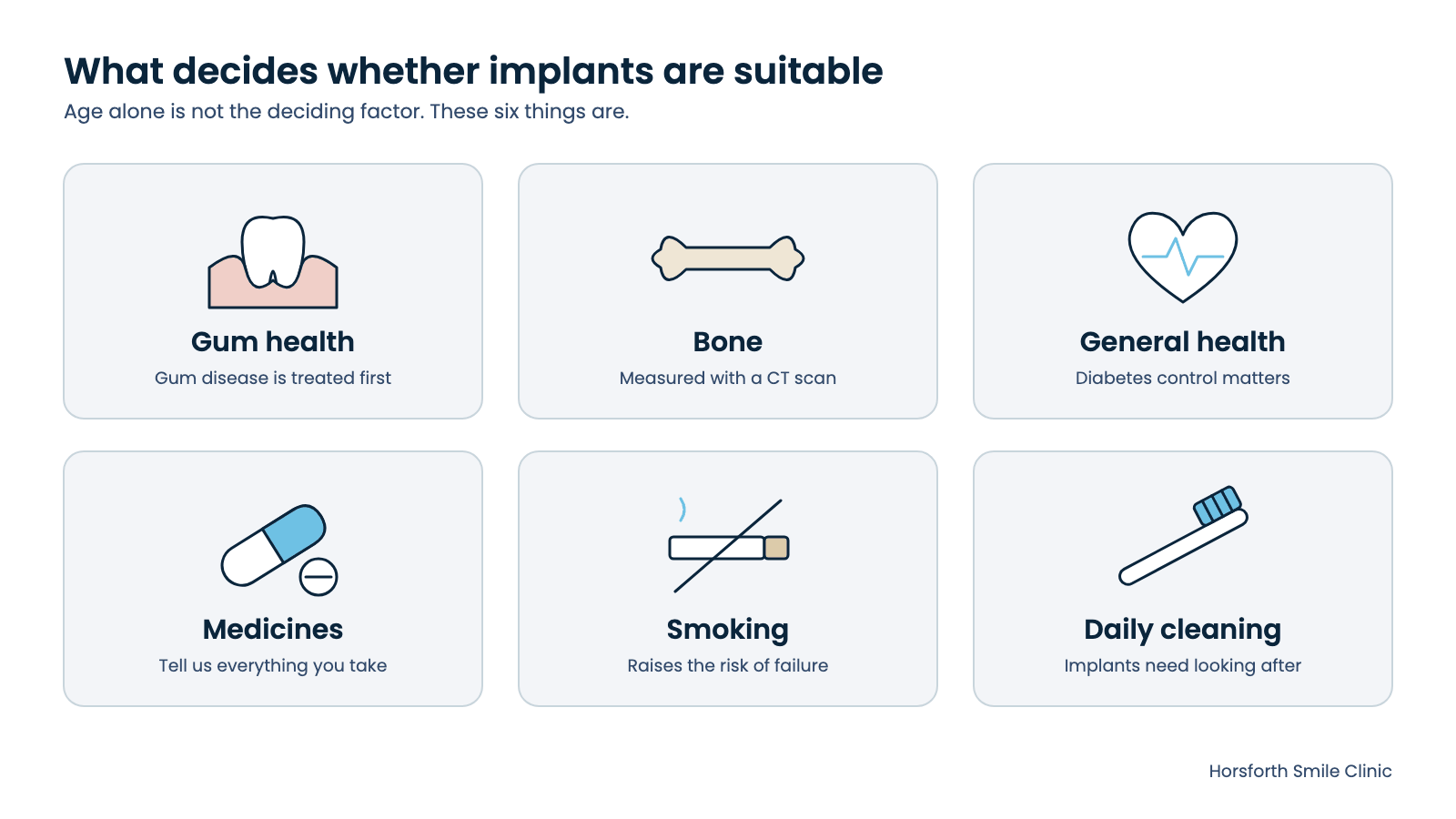
Age on its own does not rule out dental implants. A review of studies in patients aged 65 and over concluded that “age alone should not be a limiting factor for dental implant therapy” (Srinivasan and colleagues, 2017). What decides it is the health of your gums, the amount of bone, your general health and medicines, whether you smoke, and whether you can keep the implants clean.
Two honest caveats. Long-term results are somewhat lower in older patients than in younger adults, and the figures are set out below. And implants are not free at 60: NHS implant treatment is limited to a few clinical groups, whatever your age.
Suitability for treatment depends on a clinical assessment. This treatment may not be appropriate for every patient.
Is there an age limit for dental implants?
There is a lower one. Leeds Teaching Hospitals NHS Trust notes that implants “are usually only placed once you have stopped growing”.
At the other end, the research does not support a cut-off. The 2017 review pooled 11 studies of implants placed in people aged 65 and over and described implant treatment in this group as “a predictable long-term treatment option”.
So the question at 62, 72 or 82 is the same as at 42: is this mouth, and this person’s health, suitable?
What the research shows for older patients
- In patients aged 65 and over, 97.7% of implants were still in place one year after being put to use, 96.2% at five years and 91.2% at ten years. The ten-year figure comes from only three studies and carries a wide margin (95% CI 83.4% to 95.6%) (Srinivasan and colleagues, Clinical Oral Implants Research, 2017).
- Across adults of all ages, a separate review found ten-year survival of 96.4% (95% CI 95.2% to 97.5%), or 93.2% (95% CI 90.1% to 95.8%) on the authors’ more cautious analysis. In that analysis patients aged 65 and over did less well, at 91.5%, and the authors wrote of “a possible doubling of the risk of implant loss in the older age groups” (Howe, Keys and Richards, Journal of Dentistry, 2019).
Put plainly: most implants placed in older patients are still in place ten years on, but the chance of losing one is higher than it is for a younger adult. Survival also means only that the implant is still there. It does not mean there were no repairs along the way: the 2017 review lists loosened screws, chipped ceramic and denture clips that needed tightening among the common technical problems.
What matters more than your age
These are the things an assessment looks at. Several become more common with age, which is why they matter more than the birthday itself.
Gum health
The Leeds leaflet lists a history of gum disease among the things that make inflammation and bone loss around an implant more likely. Active gum disease is treated and stabilised before implants are placed.
Bone
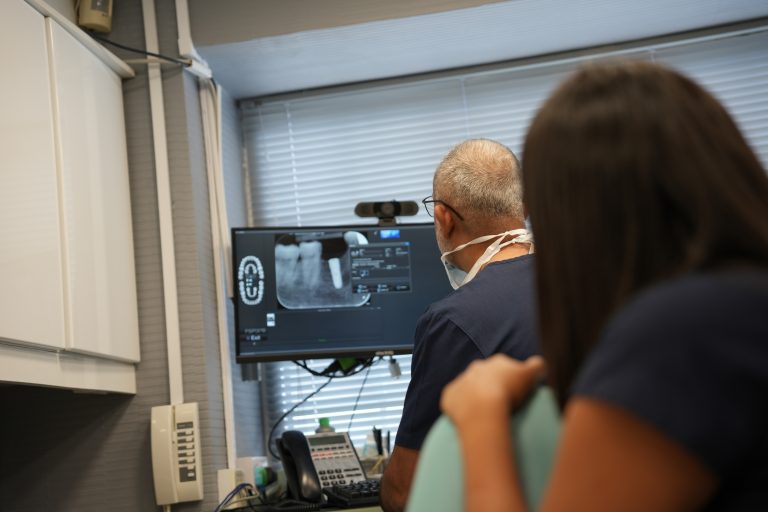
If teeth have been missing for a long time, there may be less bone to work with. A cone beam CT scan measures it, and where bone is short a graft is sometimes possible. See bone grafts and sinus lifts for dental implants.
General health and diabetes
Suitability depends partly on your overall health. The Leeds leaflet names poorly controlled diabetes as one of the things that raise the risk of an implant failing later.
Medicines
Bring a list of everything you take. Two groups matter in particular. The first is medicines for osteoporosis and some cancer treatments: the NHS describes osteonecrosis of the jaw as “a rare side effect linked with the use of bisphosphonates”, seen most often with high-dose treatment given for cancer rather than for osteoporosis, and dentists follow UK guidance on assessing that risk before surgery. The second is blood-thinning medicines, for which there is separate guidance on managing bleeding risk. Do not stop any prescribed medicine unless the doctor who prescribes it, or your dentist, tells you to.
Radiotherapy
A history of radiotherapy to the jaws is on the Leeds list of things that raise the risk of late implant failure. Tell us if you have had it.
Smoking
Guy’s and St Thomas’ NHS Foundation Trust strongly recommends stopping smoking and remaining a non-smoker, because it “lowers your risk of some complications with dental implants”.
Being able to clean them
“You must also be committed to looking after your mouth in the long term,” the Leeds leaflet says. Implants need careful daily cleaning. If arthritis, eyesight or grip would make that difficult, a denture that clips onto implants can be easier to manage than a fixed bridge, because, as the leaflet says of this type of denture, “You can remove it when required, at night and to clean the implants.”
Which options suit older patients?
There are three implant routes and two that do not involve implants. Prices are for Horsforth Smile Clinic.
- A single implant for one missing tooth: from £2,200.
- Two implants to steady a lower denture: from £3,800. The denture still comes out for cleaning. See implant-retained dentures.
- A fixed bridge on four implants for a whole arch: from £9,750 per arch, or from £12,500 for a six-implant fixed bridge. See All-on-4 dental implants.
- A conventional denture: complete dentures from £900 privately. On the NHS, dentures are a Band 3 treatment, currently £332.10 in England (NHS). See dentures.
- A bridge held by the teeth next to the gap: from £750 per unit privately, and also Band 3 on the NHS. See dental bridges.
Private prices are correct as of October 2026 and subject to clinical assessment. Implant consultations are free, and IV sedation is complimentary with all implant treatments.
Are dental implants free for over 60s?
No. Reaching 60 does not make NHS dental treatment free in England. You can get free NHS dental treatment if you or your partner receive certain benefits, including Pension Credit Guarantee Credit, and people on a low income may get help through the NHS Low Income Scheme (NHS: who can get free dental treatment). That covers NHS treatment only. As the NHS puts it, “You’ll need to pay for any private dental treatment.”
Implants themselves are rarely available on the NHS at any age. The Leeds leaflet explains that national guidelines give priority to people treated for oral cancer, people whose teeth never developed or are severely malformed, and people who have had facial or dental trauma, and adds: “Even in these cases we normally have to try conventional options before implant treatment is considered.” Our guide to help with the cost of dental implants covers what does and does not exist.
Sedation and recovery
Implant surgery “is usually done under local anaesthesia”, in the words of the Leeds leaflet, and you go home afterwards. At Horsforth Smile Clinic, IV sedation is included with implant treatment for patients who want it. Whether sedation is suitable depends on your health and your medicines, so that is assessed first.
Afterwards, the same leaflet describes swelling and bruising as usually worst 24 to 48 hours after surgery, and discomfort as usually managed with paracetamol or ibuprofen. More in do dental implants hurt? and eating after implant surgery.
Implant consultations in Leeds
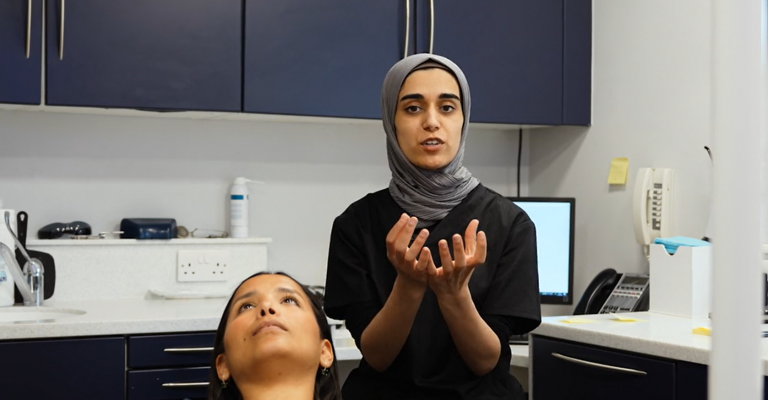
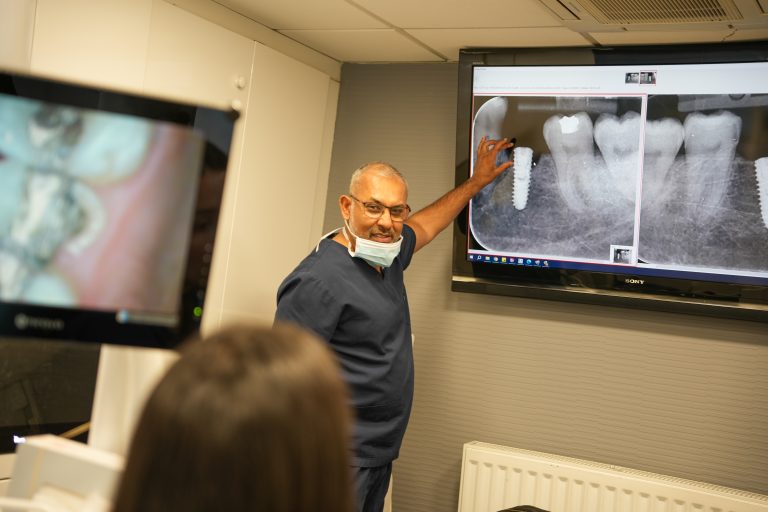
Implant consultations at our practice in Horsforth, Leeds, are free. Dr Zafar Khan examines your mouth, goes through your medical history and your medicines, and explains which options are realistic for you, including the ones that do not involve implants. Where it is needed, a cone beam CT scan (£150) measures the bone. You are given a written plan and the full cost before you decide anything.
Call 0113 258 8780 or use the contact form. More about dental implants in Leeds.
Common questions
Am I too old for dental implants at 70 or 80?
Not because of the number. The research in patients aged 65 and over concluded that age alone should not be the limiting factor. Your gums, bone, general health, medicines and ability to clean the implants are what count, and long-term survival is somewhat lower in older patients than in younger adults.
Can I have implants if I take medicine for osteoporosis?
Possibly. Tell us exactly what you take and for how long you have taken it. Some of these medicines carry a rare risk of a problem with healing in the jawbone, and your dentist will assess that risk for you before recommending any surgery.
Can I have implants if I take blood thinners?
Tell us what you take. There is UK guidance for dentists on treating people who take anticoagulant or antiplatelet medicines. Do not stop your medicine unless you are told to by the doctor who prescribes it or by your dentist.
I have worn dentures for years. Can I still have implants?
Often, yes, but there may be less bone than there was. A scan shows what is possible. If bone is short, the options include a graft, implants placed at an angle, or two implants to hold a denture steady.
Is a denture on implants better than a fixed bridge?
Neither is better for everyone. A fixed bridge stays in and is cleaned in the mouth every day. A denture on implants comes out for cleaning, involves less surgery and costs less. The All-on-4 page compares the two.
Sources
- Srinivasan M, Meyer S, Mombelli A, Müller F. Dental implants in the elderly population: a systematic review and meta-analysis. Clinical Oral Implants Research 2017;28(8):920–930. doi:10.1111/clr.12898
- Howe MS, Keys W, Richards D. Long-term (10-year) dental implant survival: a systematic review and sensitivity meta-analysis. Journal of Dentistry 2019;84:9–21. doi:10.1016/j.jdent.2019.03.008
- Leeds Teaching Hospitals NHS Trust. Dental implants: information for patients (reviewed June 2025). https://www.leedsth.nhs.uk/patients/resources/dental-implants/
- Guy’s and St Thomas’ NHS Foundation Trust. Dental implants (reviewed December 2024). https://www.guysandstthomas.nhs.uk/health-information/dental-implants
- NHS. Osteoporosis: treatment. https://www.nhs.uk/conditions/osteoporosis/treatment/
- NHS. How much NHS dental treatment costs. https://www.nhs.uk/nhs-services/dentists/how-much-nhs-dental-treatment-costs/
- NHS. Who can get free NHS dental treatment or help with dental costs. https://www.nhs.uk/nhs-services/dentists/who-can-get-free-nhs-dental-treatment/
- Scottish Dental Clinical Effectiveness Programme. Oral health management of patients at risk of medication-related osteonecrosis of the jaw. https://www.sdcep.org.uk/published-guidance/medication-related-osteonecrosis-of-the-jaw/
- Scottish Dental Clinical Effectiveness Programme. Management of dental patients taking anticoagulants or antiplatelet drugs, 2nd edition, 2022. https://www.sdcep.org.uk/published-guidance/anticoagulants-and-antiplatelets/