The short answer
For the first day or two, eat cool, soft food and chew away from the surgical site. Avoid hot food and drink for around 48 hours. Dairy is worth timing carefully if you have been prescribed a tetracycline antibiotic such as doxycycline, because calcium binds to the drug in the gut and reduces how much of it you absorb — NHS Scotland guidance advises separating the two by two hours either side. NHS medicines guidance for amoxicillin states it can be taken before or after food and does not raise dairy as a consideration. Return to normal eating is guided by comfort rather than a fixed number of days, and by any instructions specific to your restoration.
Does dairy need avoiding after implant surgery?
Patients often ask whether dairy needs avoiding. The one documented reason to time it carefully is medicines-related.
The part that is evidenced: antibiotic absorption
Some tetracycline antibiotics — doxycycline, tetracycline and oxytetracycline — bind to multivalent cations such as calcium, iron and magnesium in the gut, forming complexes the body cannot absorb. NHS Scotland’s Right Decisions antimicrobial guidance on this interaction, approved by the NHS Tayside Area Drug and Therapeutics Committee in 2023, advises separating doxycycline from calcium-containing products by two hours either side, and records potential reductions in antibiotic blood levels of 90–100% where the two are taken together. The same table lists lymecycline and minocycline as not affected by a moderate amount of dairy products.
That guidance is candid about the uncertainty. It notes that the BNF and manufacturers’ product information indicate calcium salts and milk have only a minimal effect on doxycycline specifically, while other reference sources report a clinically meaningful interaction — so the consensus position is to err on the side of caution and space the doses apart.
So there is a real reason sitting underneath the advice. It is a medicines-timing issue, not a wound-healing one, and what it justifies is “keep dairy two hours away from your antibiotic dose”, not “avoid dairy for a week”.
It may not apply to you at all
Not everyone having an implant placed takes antibiotics afterwards. The Cochrane review of antibiotics at dental implant placement (Esposito, Grusovin and Worthington, 2013) found that 2 g or 3 g of amoxicillin given orally as a single dose one hour before surgery reduced implant failures, with a number needed to treat of 25 (95% CI 14 to 100) — a wide interval that is worth reading alongside the headline figure. The same review concluded that whether antibiotics taken after surgery are beneficial remains unknown.
If you have been given amoxicillin, NHS medicines guidance states that it can be taken before or after food, and does not raise dairy as a consideration.
What the aftercare documents actually cover
Three NHS post-operative aftercare documents we checked — from Guy’s and St Thomas’, Hull University Teaching Hospitals and Kent Community Health — give detailed instructions on eating, rinsing, smoking, alcohol and activity after oral surgery. None of them mentions dairy at any point. What all three do warn about is heat, hard or sharp food, suction, and disturbing the blood clot.
The practical conclusion: ask your own dentist which antibiotic you are on, if any, and time it accordingly. Beyond that, the questions the guidance does address are texture and temperature — and cold, soft food fits the first 48 hours rather well.
The first 24 hours
Post-operative advice varies slightly between NHS trusts, but the common ground is consistent:
- Do not eat while your mouth is still numb — you can bite or scald yourself without feeling it (Hull University Teaching Hospitals).
- Kent Community Health advises nothing to eat or drink for the first three hours.
- Avoid hot food and drink for two days, because heat can restart bleeding (Guy’s and St Thomas’).
- Eat soft food and chew on the other side of your mouth (Kent Community Health).
- Take care with hard and sharp foods such as nuts and crisps (Hull).
- Kent advises not sucking or touching the wound; that reasoning extends to straws.
- No alcohol on the day of treatment (Hull); Kent extends this to 24–48 hours.
- Do not rinse your mouth on the day of surgery — it can wash out the clot and delay healing (Guy’s and St Thomas’).
- Take it easy: no bending, heavy lifting or exercise that day (Kent), and avoid exercise for a few days afterwards (Guy’s and St Thomas’).
On what the days immediately after surgery feel like, rather than what to eat, we have written separately on what implant treatment actually feels like.
Days two to seven
From the day after surgery, Guy’s and St Thomas’ advises rinsing with a glass of warm water containing a teaspoon of salt, four times a day, for four to five days. Hull’s guidance also starts salt-water rinsing the morning after surgery — a teaspoon of table salt dissolved in a cup of warm water — without specifying a frequency.
Stay on soft food until you can chew comfortably rather than to a fixed calendar. Brush your teeth as normal but avoid the surgical site on the first night, then brush gently around it as things settle (Hull).
When can you eat normally again?
There is no single evidence-based number, and any site that gives you one has invented it. Guy’s and St Thomas’ puts the period where solid food is likely to be uncomfortable at one to two days — but that describes the soft tissue settling, not the implant integrating.
If you are wearing a temporary restoration or waiting for a final crown or bridge, what you are allowed to chew on is set by your loading protocol, which is specific to your case and your bone. That instruction comes from your dentist, not from a website. We cover the integration timeline separately in how long dental implants last.
Can you do anything to heal faster?
There is no aftercare step with evidence behind it that shortens osseointegration. What the evidence does identify is what works against it.
Smoking has a measurable effect on early implant failure. A 2024 systematic review and meta-analysis in the Journal of Dentistry, pooling 32 studies covering 59,246 implants, found smoking associated with an odds ratio of 2.59 (95% CI 2.08–3.23) for early implant failure at implant level. Separately, Hull’s oral surgery guidance advises avoiding smoking on the day of treatment and ideally for at least five days, to reduce the risk of dry socket.
Keep the rest of your mouth clean while you are avoiding the surgical site itself, brushing gently around it as Hull’s guidance describes.
Tell your dentist about your medical history and medicines before surgery, not after. Conditions and drugs that affect healing change the plan.
Once the implant has healed
The European Federation of Periodontology’s S3-level clinical practice guideline on peri-implant diseases (Herrera et al., Journal of Clinical Periodontology, 2023) states that once implants are loaded and in function, a structured supportive peri-implant care programme should be in place, including periodic assessment of the tissues around them. On home cleaning devices, a 2025 systematic review in the International Journal of Implant Dentistry reported no meaningful difference between interdental brushes and floss on descriptive analysis, and found no statistically significant difference between brushing alone and brushing plus a water flosser on bleeding and plaque scores — with the overall evidence rated as limited. Longer-term maintenance is covered in how long dental implants last.
Signs worth acting on
Contact your dental team if:
- bleeding does not stop after ten minutes of firm pressure on a gauze pack (Guy’s and St Thomas’ advise contacting your dentist, and attending A&E in an emergency)
- pain is increasing rather than gradually settling
- swelling is increasing rather than settling
- there is a bad taste or smell you cannot rinse away
- an implant or restoration feels loose
- numbness has not resolved as expected
Suitability for treatment depends on a clinical assessment. This treatment may not be appropriate for every patient.
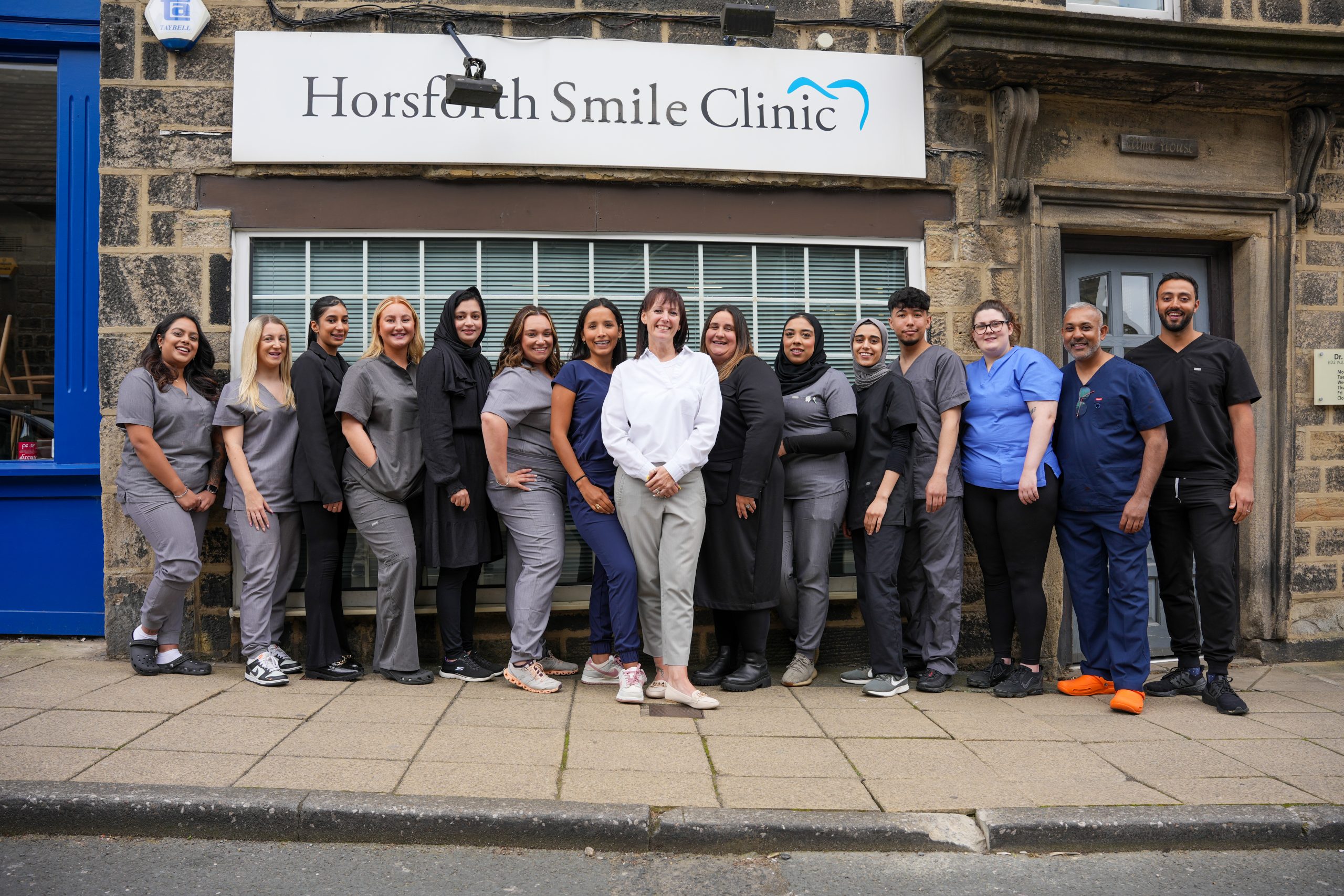
If you are considering treatment, or you have had an implant placed elsewhere and want it reviewed, you can read more about dental implants in Leeds at our Horsforth practice.
Sources
- Yoong E. Reducing Antibiotic Treatment Failure — a focus on tetracycline and fluoroquinolone antibiotics interaction. NHS Scotland Right Decisions, approved by NHS Tayside ADTC, 26 April 2023. https://www.rightdecisions.scot.nhs.uk/media/2bee2jgi/tetracycline-and-fluoroquinolone-nteractions-reducing-antibiotic-treatment-failure-20230426.pdf
- NHS. How and when to take amoxicillin. https://www.nhs.uk/medicines/amoxicillin/how-and-when-to-take-amoxicillin/
- Esposito M, Grusovin MG, Worthington HV. Interventions for replacing missing teeth: antibiotics at dental implant placement to prevent complications. Cochrane Database of Systematic Reviews 2013, Issue 7, CD004152. doi:10.1002/14651858.CD004152.pub4
- Guy’s and St Thomas’ NHS Foundation Trust. Dental surgery and recovery. https://www.guysandstthomas.nhs.uk/health-information/dental-surgery-and-recovery
- Hull University Teaching Hospitals NHS Trust. Post-operative mouth care following oral surgery. https://www.hey.nhs.uk/patient-leaflet/mouth-care-following-oral-surgery/
- Kent Community Health NHS Foundation Trust. Tooth extraction after care. https://www.kentcht.nhs.uk/leaflet/tooth-extraction-after-care/
- Fan YY, Li S, Cai YJ, Wei T, Ye P. Smoking in relation to early dental implant failure: a systematic review and meta-analysis. Journal of Dentistry 2024;151:105396. doi:10.1016/j.jdent.2024.105396
- Herrera D, Berglundh T, Schwarz F, Chapple I, Jepsen S, Sculean A, Kebschull M, Papapanou PN, Tonetti MS, Sanz M. Prevention and treatment of peri-implant diseases — the EFP S3 level clinical practice guideline. Journal of Clinical Periodontology 2023;50(S26):4–76. doi:10.1111/jcpe.13823
- Bishti S, Wolfart S, Tuna T. Optimizing implant hygiene: the added value of interproximal cleaning devices around implant-supported restorations — a systematic review and meta-analysis. International Journal of Implant Dentistry 2025. doi:10.1186/s40729-025-00652-4